Meet the scientists: our National Geographic Society grantees
Updated: 6 days ago

In short: On August 11, 2026, the National Geographic Society and forNature announced 10 Explorer-led projects spanning five continents, each working to build the scientific, legal and community evidence behind the Rights of Nature movement.
What is the forNature program?
The forNature program is a collaboration between National Geographic Explorer Callie Veelenturf and the National Geographic Society, made possible through the support of The Alfred Kobacker and Elizabeth Trimbach Fund. It mobilizes a global community of researchers and conservationists, backed by National Geographic Society's grant-giving expertise, to gather the data and build the tools that turn the Rights of Nature from principle into enforceable protection. As Callie put it: "Recognizing the intrinsic rights of Nature will support a shift in how Nature is considered in decision making and represents a transformative solution to the biodiversity, pollution and climate crises."
Ian Miller, chief science and innovation officer at the National Geographic Society, described the program's approach: "The forNature program brings together science, storytelling, education and community-based conservation through these 10 remarkable Explorers. Together, we're conducting work on the ground and generating awareness, all with the goal of driving real action to advance the Rights of Nature and safeguard biodiversity."
Meet the 2026 cohort
Cristian Moreno (Chile) is developing the world's first Rights of Nature framework for the endangered fungus Butyriboletus loyo, working with Indigenous Mapuche communities to combine ecological science with Traditional Mycological Knowledge.
Elodie Freymann (Uganda) is building the first comprehensive database tracing the connections among trees, humans and wild chimpanzees in Uganda's Budongo and Bugoma forest reserves, to help implement Uganda's Rights of Nature law.
Inza Koné (Côte d'Ivoire) is documenting the scientific evidence, local knowledge and governance practices behind the locally-led conservation success of the Tanoé-Ehy Forest, to create a repeatable model for rights-based ecosystem protection.
Iva Njunjić (Montenegro) is combining ecological research and DNA assessment to document food webs in Montenegro's Piva and Komarnica Rivers, two of Europe's last free-flowing rivers, threatened by a proposed hydropower dam, and building the evidence for the Komarnica's right to flow, regenerate and thrive.
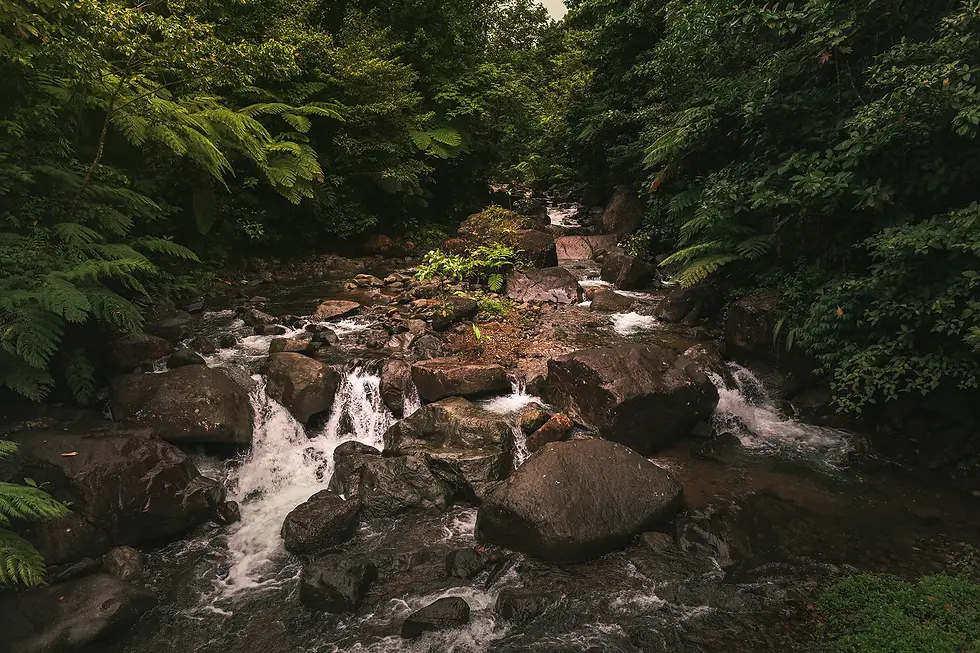
Jeanelle Brisbane (Dominica) is partnering with the Kalinago Council to co-design community river health checks along the Pagua River, weaving ancestral knowledge with field science toward a Declaration of Care for Living Waters.
José de Jesús Vargas González (Panama) is working with the Emberá and Wounaan communities to document forest loss in the Darién-Chocó and the threat to harpy eagles, developing a biocultural framework that supports Panama's Rights of Nature law.
Reed Goodman (United States) is combining archaeology and historical ecology at South Carolina's Hobcaw Barony reserve, working with Indigenous and descendant communities to inform a Rights of Nature framework for the estuary's right to remain fluid and connected.
Rosa Vásquez Espinoza (Peru) is mapping the population and distribution of Amazonian stingless bees with local and Indigenous communities, supporting Peru's first Stingless Bee Corridor and advancing the Rights of Stingless Bees.
Susannah Buchan (Chile) is building the scientific and community case for Rights of Nature protection for Chile's Humboldt Current submarine canyons, mapping how they sustain biodiversity, fisheries and local livelihoods.
Tiasa Adhya (India) is tracing the movement pathways of the fishing cat across three east Indian floodplains, informing a legal brief for the species' rights to safe habitat and creating the Living Floodplain Atlas to engage local communities.
What ties the ten projects together
Every project blends scientific data collection with Indigenous and local knowledge, and each is aimed at producing something concrete: a legal framework, a database, a corridor, a declaration. Together, the projects are meant to empower the scientific community with practical tools, mobilize a global network of researchers, collect the evidence policymakers need, and build public understanding of what Rights of Nature protection looks like in practice, on five continents at once.